Source code & documentation
Browse the Austin source archive and related player manuals, technical notes, and historical documents.
DECWAR was among the first multiplayer computer games—eighteen players battling across a shared galaxy on UT Austin's PDP-10 in 1978. We're working to ensure this pioneering software and its cultural context survive.
The current version is offered for feedback and testing as a sustainable modern implementation of DECWAR.
Prefer a Telnet client? telnet play.decwar.org 2423
An organization bringing together faculty, alumni, archivists, and technologists.
DecwarOrg exists to provide a permanent institutional home for the research, preservation, and historical reconstruction of DECWAR—a multiplayer space combat game that emerged from the University of Texas Computation Center in 1978.
Written in MACRO-10 assembly and Fortran for the DEC PDP-10, DECWAR allowed up to eighteen simultaneous players to engage in tactical starship combat across a shared galactic map. The university distributed the game on magnetic tape for a nominal $50 fee, and it spread to PDP-10 installations worldwide.
More than a technical artifact, DECWAR represents an early example of networked social gaming. The terminal rooms where players gathered became proto-online communities, complete with their own social hierarchies, cultural norms, and collective memories.
Our current work spans source preservation, historical emulation, formal specification, software reconstruction, public access, and scholarly research.
Cataloging and preserving the Austin and CompuServe source archives, documentation, maps, and build materials.
Maintaining a reproducible PDP-10 reference build of the reconstructed Austin game and documenting every required intervention.
Open the Austin 2.3 reconstructionWriting a platform-independent specification of the game’s commands, state, rules, timing, multiplayer behavior, and output.
Reimplementing DECWAR in TypeScript, with Austin as the default and CompuServe retained as a distinct variant.
An early alpha of the modern port is available for testing. Play in a web terminal or connect with a Telnet client:
Play in your browsertelnet play.decwar.org 2423
Developing the early Star Trek chronology, oral histories, and scholarly work in game studies, platform studies, and software preservation.
Help review the early Star Trek chronologyBegin with the preserved game, then explore its source, documentation, and stories.
 1979
1979
UT Austin’s institutional record preserves binary executables migrated from a DECUS magnetic tape, along with a historical description of the game.
View the archival record →Browse the Austin source archive and related player manuals, technical notes, and historical documents.
See the preservation work in action and hear from people connected to DECWAR and its history.
Visit the video channel →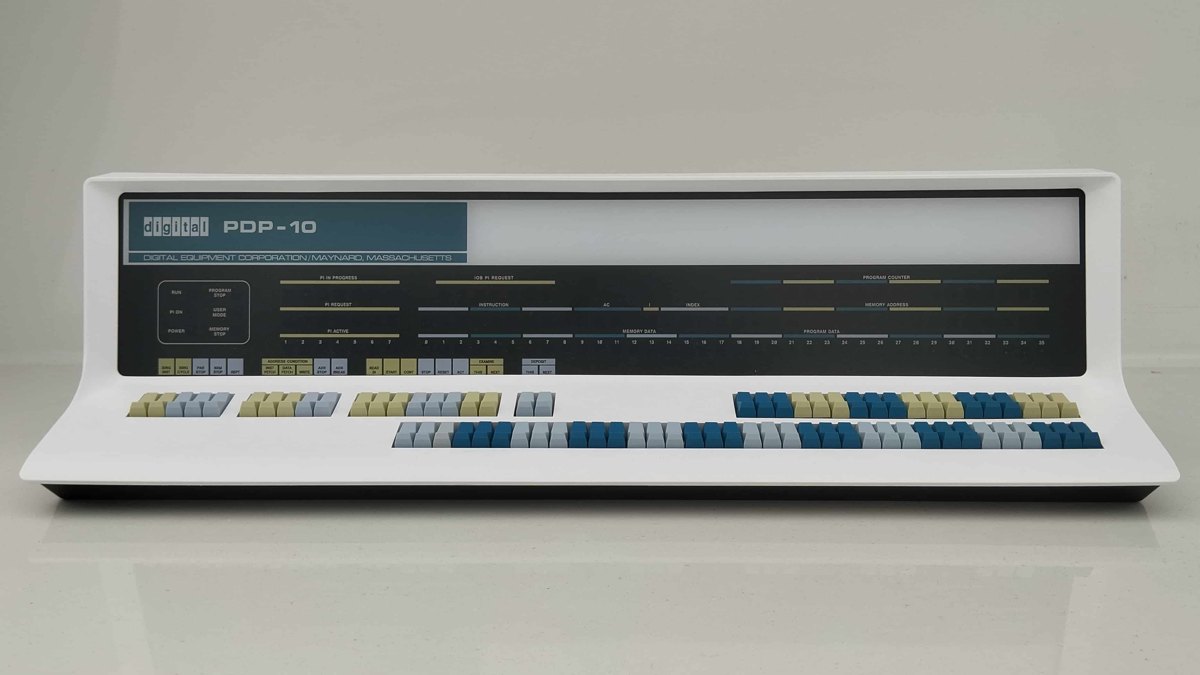
The PiDP-10 is a physical PDP-10 replica built around the SIMH simulator and a Raspberry Pi. It supports TOPS-10 and can be used to install and run DECWAR.
The lineage of Star Trek games at UT Austin and the current preservation project, 1971–present
High school senior Mike Mayfield creates a text-based Star Trek game on an SDS Sigma 7 at UC Irvine—inventing the tactical starship simulation rendered entirely in ASCII.
Mayfield rewrites in HP BASIC. The version spreads widely via David Ahl's 101 BASIC Computer Games, seeding Star Trek variants worldwide.
Grady Hicks and Jim Korp develop a BASIC Star Trek variant for UT Austin's CDC 6600, gaining popularity among Computation Center students.
Dave Matuszek and Paul Reynolds create an expanded Fortran version on the CDC 6600 with significant gameplay depth.
The first multiplayer variant emerges—a two-player Fortran game demonstrating the appeal of human-versus-human starship combat.
Bob Hysick and Jeff Potter release DECWAR for the PDP-10. Supporting eighteen simultaneous players, UT Austin distributes copies on tape for $50—spreading globally.
Major update adds new ship classes, expanded combat mechanics, and improved multiplayer synchronization.
The final major release. DECWAR runs on dozens of systems globally before fading as institutions migrate to newer architectures.
DecwarOrg preserves the surviving source archives, maintains the Austin 2.3 reference build under PDP-10 emulation, and researches DECWAR and its predecessors. The modern TypeScript port is available as an early alpha Telnet service; the formal specification and public access to the historical emulation remain in preparation.
Conversations about early Star Trek computer games, DECWAR, and the machines and networks around them.
Dave Matuszek · Part 1
How early Star Trek games developed into DECWAR.
Dave Matuszek · Part 2
A closer look at building an early Star Trek program.
Clive Dawson
Memories of DECWAR, DEC-10 systems, and the early ARPANET.
Recent developments in DECWAR preservation and related projects.
January 2026
SIGGRAPH SOIREE 2026 Symposium
Virtual event
A discussion of the collaboration among two classes, the symposium, and university resources required to revive DECWAR as a historical game and creative work.
November 2025
UT Austin
AudioPixel Collider installation
An interactive installation presenting DECWAR as both a historical artifact and a living system: a game that can be replayed, studied, and interpreted through new media, especially sound.
The installation placed the original terminal experience beside a contemporary reconstruction whose live game activity drove spatial audio and student-created visual and sonic works.
The original text-only terminal experience, reconstructed through coordinates, commands, and system messages.
A modern reconstruction translating movement, combat, and destruction into spatial audio.
Sonification, ambient sound, and visual interpretations using DECWAR as a generative system.
While DecwarOrg focuses on software preservation, our colleagues at Obsolescence are undertaking a complementary effort: a complete virtual AI Lab - hardware and software - as it stood at MIT in the 1970s, free to play with on your laptop.
Unsurprisingly, this AI Lab of the 1970s has become a mythical place in the world of computer science. A lot of computer jargon and the Hacker Ethic can be traced back to the Lab and its people, as do a lot of now-common software tools.
Read about the ITS reconstructionDecwarOrg is led by faculty and alumni of The University of Texas at Austin. We welcome researchers, developers, archivists, former players, and others who can contribute evidence, expertise, or code.